
Blog
Urine Drainage Bag Design: Anti-Reflux Valves, Sampling Ports, and Capacity Choices That Affect Infection Control

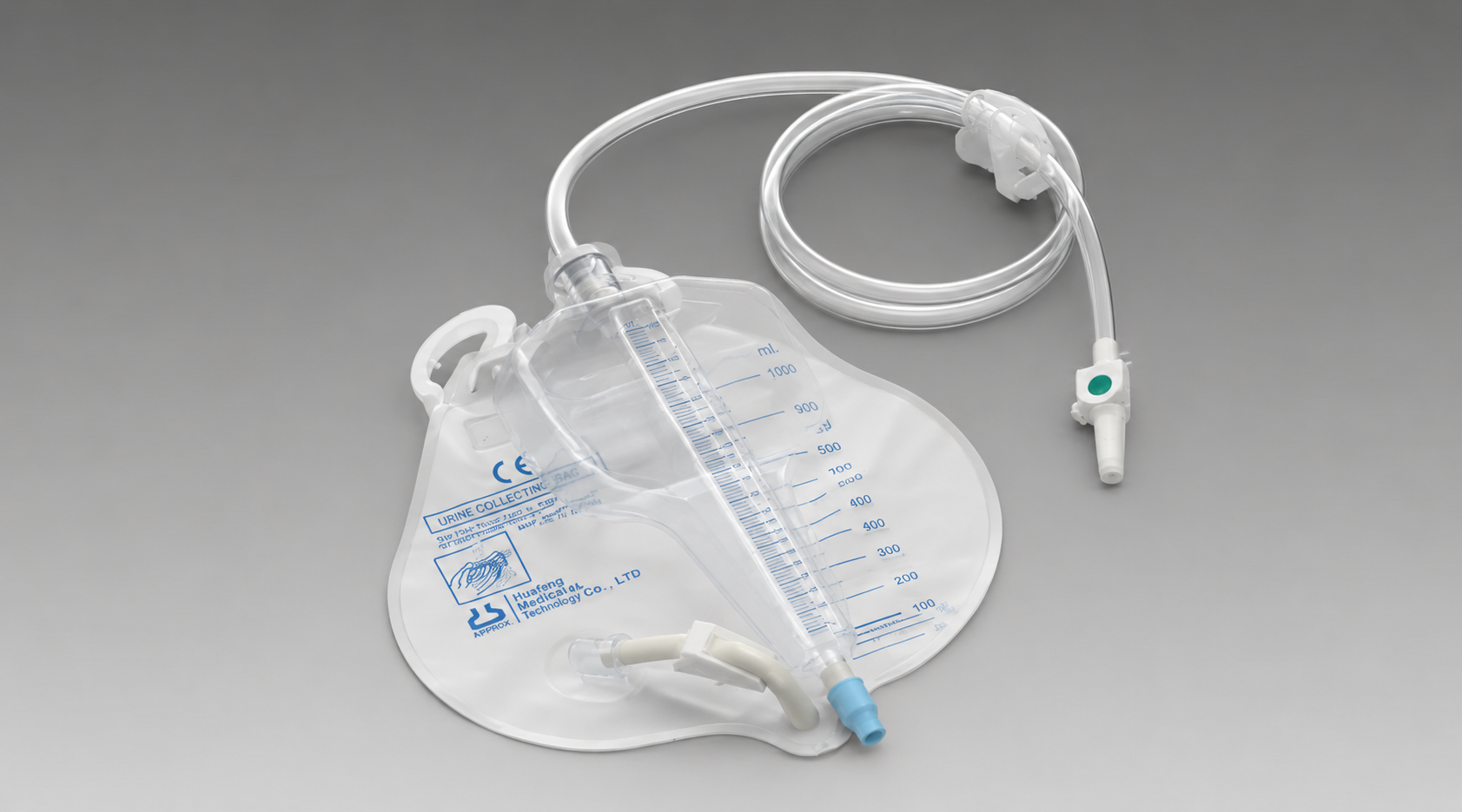
A urine drainage bag looks like a simple component compared to the catheter it connects to, but its design directly affects infection control outcomes. Catheter-associated urinary tract infection remains one of the most common healthcare-associated infections, and a meaningful share of the risk comes not from the catheter itself but from bacterial migration through the drainage system — specifically, urine flowing backward from the bag into the tubing and catheter when the bag is mishandled, tipped, or positioned above bladder level. The features built into a drainage bag — anti-reflux valves, sampling ports, capacity, and outlet design — are what determine whether the closed system actually stays closed in practice.
Anti-Reflux Valve Mechanics
An anti-reflux valve sits at the inlet of the drainage bag, between the tubing and the collection chamber, and is designed to permit one-way flow only. Urine entering from the catheter passes through into the bag, but the valve closes if pressure reverses — for example, if the bag is lifted above the patient or squeezed during handling. The clinical importance comes down to bacterial ascent: without a functioning anti-reflux mechanism, contaminated urine in the bag has a direct path back toward the bladder, and this backflow is a recognized contributor to CAUTI risk in patients with indwelling catheters.
Valve designs vary by manufacturer. Some use a simple flexible membrane that flexes open under forward flow and seals against a valve seat under reverse pressure — a passive mechanical design with no moving parts beyond the membrane itself, which reduces failure points. Others use a hinged check-valve element. For OEM sourcing, the simpler passive designs generally have lower long-term failure rates because there is less to wear out, but should still be validated for consistent sealing performance across the bag’s stated wear duration, typically five to seven days for a standard closed system.
Sampling Ports and the Closed-System Principle
Modern drainage bags include a needle-free sampling port — typically a self-sealing rubber or silicone septum positioned on the drainage tubing — that allows urine specimen collection without breaking the closed system. Before needle-free ports became standard, specimen collection required either disconnecting the catheter from the bag (a major infection risk) or inserting a needle through the tubing wall, which created a puncture point that could itself become a contamination route over repeated use.
The port should be compatible with standard Luer-lock or slip-tip syringes, and the surrounding tubing design should allow the clinician to occlude the tube below the port to build up a urine column for aspiration without needing additional tools. For kit assemblers including drainage bags as part of a larger urology kit, port placement and compatibility with the syringes included elsewhere in the kit is worth confirming explicitly rather than assuming standard compatibility.
Capacity: Bedside vs. Leg Bags
Drainage bags are sized for different use contexts. Bedside bags, typically 2,000 mL capacity, are designed for overnight or continuous hospital use, where high volume capacity reduces the frequency of emptying and the associated infection risk from repeated manipulation of the system. Leg bags, generally 500 mL to 750 mL, are designed for ambulatory patients and attach discreetly to the thigh or calf, allowing daytime mobility for catheterized patients who are not bed-bound. Many long-term catheter users switch between a leg bag during the day and a larger bedside bag at night, connected via a compatible tubing adapter rather than disconnecting the catheter itself.
Product segment data indicates that standard and large-capacity bedside bags account for the majority of revenue share in the urinary drainage bag market, reflecting their dominant use across acute care hospitals, post-operative settings, and long-term care facilities where continuous monitoring of urine output is standard practice.
Outlet Valve and Emptying Hygiene
The outlet at the bottom of the bag — used to empty accumulated urine — is a secondary contamination risk point if poorly designed. A twist-valve or lever-clamp outlet that requires the emptying spout to make contact with a collection container increases splash risk and the chance of touch contamination. Better designs incorporate a recessed or shielded spout with a positive-close mechanism that minimizes the need for direct contact during emptying. For kits or bags marketed toward home care use, where the person emptying the bag may not have clinical training, outlet design that minimizes splash and simplifies hygienic technique is a meaningful product differentiator, not just a convenience feature.
Material and Transparency
Drainage bags are typically made from PVC or vinyl, chosen for flexibility and durability under repeated handling. Transparency is a functional requirement, not just a manufacturing default — clear graduated markings along the bag wall allow accurate visual monitoring of urine output, which is a standard nursing observation in both acute and long-term care settings. Latex-free construction has become the de facto standard given the prevalence of latex sensitization concerns, and most current-generation bags on the market are labeled accordingly.
Specification Checklist for Procurement
When evaluating a urine drainage bag supplier, confirm the anti-reflux valve mechanism and request validation data covering its full stated wear duration, not just initial function testing. Confirm sampling port material and syringe compatibility. Specify capacity by use case — bedside vs. leg bag — rather than assuming a single SKU covers both contexts. And confirm tubing length and connector type compatibility with the catheter systems your kit or distribution line already includes, since a mismatch in connector diameter between catheter and bag tubing is a basic but recurring sourcing error when components are sourced from different suppliers.
Changfeng Medical supplies urinary drainage bags and related urology consumables with anti-reflux valve and sampling port configurations suited to both hospital and home care distribution channels. Specifications and samples are available through our product catalog.